
Generative
Generative MIDI sequencing on iPad
Set the odds, not the notes. Oxidzr's Stochastic mode invents a line from the probabilities you give it, for as long as the transport runs. When it plays something you love, you keep it.
The workflow is the same every time: generate, capture, edit, perform. Stochastic mode does the generating, the Loop section captures, a Mono sequencer is where you edit by hand, and the patterns and chain are where you perform it with the rest of your parts.
1. Generate
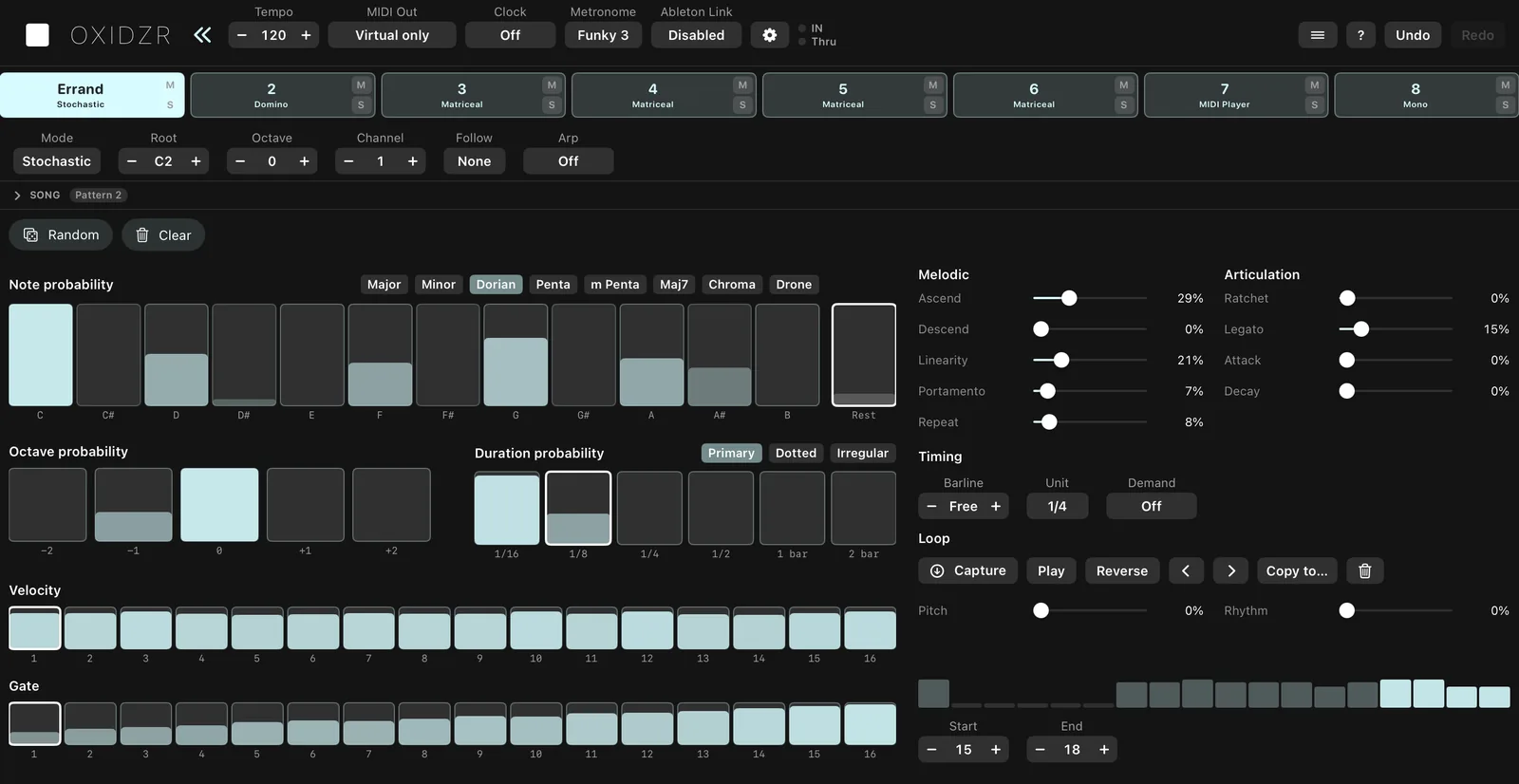
Pick a sequencer and set Mode to Stochastic. Instead of a step grid you get rows of bars:
- Note probability: 12 bars, one per semitone counted up from Root. A bar at 100% is twice as likely as one at 50%, and a bar at 0 never plays. The presets (Major, Minor, Dorian, Penta, m Penta, Maj7, Chroma, Drone) set all twelve at once.
- Rest: the chance that any event is silence.
- Octave probability: how often the line jumps up or down an octave or two.
- Duration probability: the lengths it can draw, from 1/16 to 8 bars, including dotted lengths and lopsided ones such as 5/16 and 7/16.
- Velocity and Gate: 16 bars each, a loudness and length shape across the bar for accents and staccato.
Then the sliders that make it sound like a melody rather than noise:
- Linearity favours notes close to the previous one, for stepwise, singable lines.
- Ascend and Descend lean the line upwards or downwards.
- Repeat replays the previous note exactly, for motifs that stutter.
- Ratchet, Legato, Portamento, Attack and Decay are each a chance per note.
Not sure where to start? Random builds a setup that plays well straight away: a scale preset, a rhythm, a little space and motion. Every bar takes effect on the next event, so steer it while it plays.
Keep it in time and in key
- Barline with Unit forces the line back onto a bar every so many beats, however irregular its lengths. Barline 7 with Unit 1/8 gives a 7/8 cycle.
- Demand makes every event a sixteenth, for a steady pulse with generated pitches.
- Follow moves each generated note to the nearest note of another sequencer’s chord. Put a progression on a Chord sequencer and the generator follows its harmony.
2. Capture
Oxidzr always remembers the last 18 events the generator played, rests included. Tap Capture in the Loop section and they become a loop that plays straight away. The last four are what loops at first, so you hear the bit you just liked. Widen Start and End to take in more of it.
- ◀ / ▶ shifts the captured events by one place, to hear the neighbouring phrase.
- Reverse plays the range backwards.
- Capture works after you stop, too, so you can stop the moment you hear something good.
3. Let it drift, or freeze it
A captured loop can evolve slowly instead of repeating exactly:
- Pitch is the chance, each time an event comes round, that it’s replaced by a fresh draw from the bars.
- Rhythm is the chance it draws a new length.
Changes are kept, so the loop wanders over minutes rather than flickering back. Leave both at 0% to keep it fixed.
4. Edit it by hand
Copy to… writes the loop into another sequencer as a Mono pattern, with the exact pitches and each note on the sixteenth it played. Now it’s an ordinary step sequence. Drag notes, change lengths, add ties, or give a note Accumulate so it climbs or falls a little every pass.
5. Perform it
Store the result in a pattern, build more around it, and switch patterns on the bar line or arrange them in the chain. See Patterns, the chain and the performance loop.
More generative tools
Stochastic isn’t the only place where Oxidzr makes its own decisions:
| Where | What it does |
|---|---|
| Accumulate (Mono, Poly, Domino, Saga) | A note moves by an amount each time it plays, within bounds, with a chance and a random size if you like. |
| Probability on steps | Any step, trigger or stage can play only sometimes. |
| Saga Rng | A stage wanders up or down by a random number of scale steps each time it plays. |
| Matriceal | Random lanes of different lengths recombine into lines that take a long time to repeat. See Polymetric sequencing. |
| Multitrack drum generator | Kick, snare and hat parts generated fresh every loop, from sparse to busy, with syncopation and chaos. |
| Mod lanes | Rnd and QRnd orders, and Random, for CC and transposition that never quite repeat. |
Every mode’s details are in the full guide.